


We’re thrilled to share the launch of a brand-new video podcast episode, “Unlocking Rhythm: The Ski-Hill Graph and the Hidden Architecture of Music”, now available on YouTube!
🎥 Watch the full episode here »
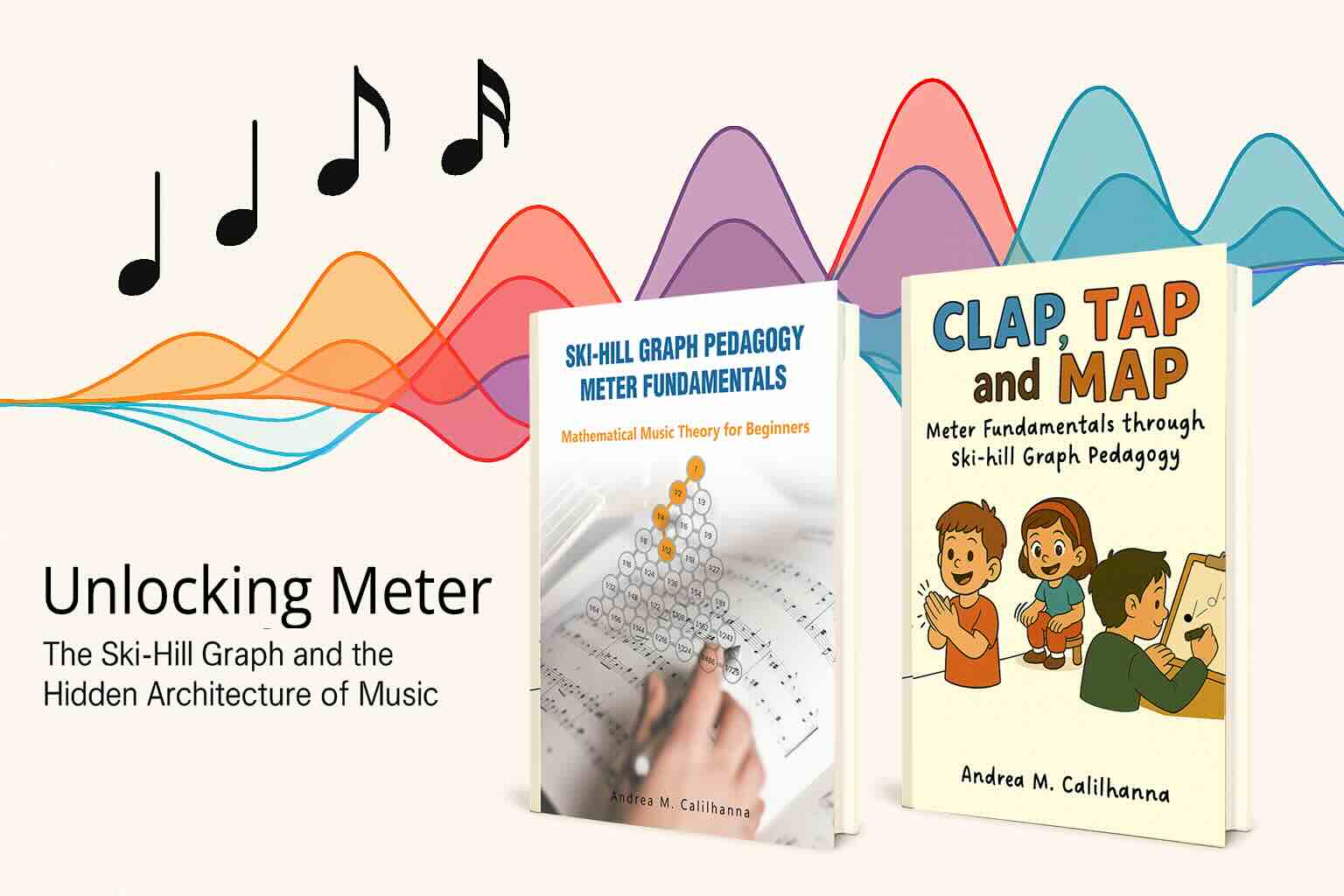 In this fascinating discussion, Andrea M. Calilhanna’s research takes center stage — bringing to life her innovative approach to teaching meter fundamentals through Ski-hill Graph Pedagogy. This video aims to make contemporary meter theory engaging and understandable for everyone — from experienced educators and musicians to anyone curious about how rhythm really works beneath the surface of music.
🧠 Bridging the Gap Between What We Hear and What We See
We all know that feeling — when the rhythm of a song just clicks. You tap your foot, nod your head, and everything feels perfectly in sync. But if you try to explain why it feels right, or to teach that feeling to someone else, things get tricky. Traditional time signatures like 4/4 and 3/4 explain notation, but not the experience of rhythm.
That’s where Ski-hill Graph Pedagogy comes in. Developed by Andrea M. Calilhanna and inspired by Yale University theorist Richard Cohn, this method bridges the gap between the mathematical structure of rhythm and the human experience of feeling it.
🎵 From Notation to Perception: Understanding the Hidden Architecture of Music
This podcast explores how Ski-hill Graphs — simple, visual representations of musical meter — can transform how we understand timing, phrasing, and pulse.
Instead of seeing rhythm as a grid of fixed beats, learners use fractions, geometry, and listening to map how rhythm truly flows.
Listeners discover how:
- Notation ≠ Meter: Time signatures describe symbols, not sensations.
- Ski-hill Graphs reveal the layers of rhythm — from the smallest pulses to long hyperpulses spanning whole phrases.
- Mathematics and music connect naturally, offering new insight into expression and performance.
- Beginners and educators alike can simplify rhythm teaching using Andrea’s intuitive three-step listening process: Clap, Tap, and Map.
🌍 A Global, Inclusive Vision for Music Education
One of the most powerful aspects of this episode is its inclusive perspective. The Ski-hill Graph Pedagogy allows teachers and students to explore complex rhythms from diverse musical cultures — from African polyrhythms to jazz swing — with respect for their mathematical and perceptual depth.
By moving beyond purely Western notation, Andrea’s approach supports a more ethical, global understanding of music — one that values listening, feeling, and critical thinking as much as reading notes.
💡 Why You Should Watch
If you’re a music educator, student, or lover of rhythm, this video offers a fresh, eye-opening way to connect with music.
You’ll learn how to:
- Simplify complex rhythmic concepts using visual graphs.
- Reduce confusion about meter and time signatures.
- Strengthen timing, confidence, and performance skills.
- See how music connects with math, cognition, and creativity.
This episode is both educational and inspiring — showing that music theory doesn’t have to be abstract or intimidating. It’s about feeling the structure, seeing the rhythm, and understanding the heartbeat of sound.
🎧 Watch now and explore the hidden architecture of rhythm:
👉 https://www.youtube.com/watch?v=GjSujAsJmwg
We hope this episode helps you listen differently — and more deeply — to the music you love.
Tags: #MusicEducation #MusicTheory #Rhythm #Meter #Podcast #ContemporaryMusic #LearningThroughListening #SkiHillGraphPedagogy #AndreaCalilhanna
